
GENERAL TIN SILICONE FOR SHOE MOLD MAKING
Shoe Mold Making Silicone for Crisp Tread, Clean Release & Fast Sampling
Cost-effective RTV-2 tin-cure silicone for shoe sole molds, outsole prototypes, footwear pattern duplication, plaster models, PU resin samples, and small-batch development.
- Capture fine tread, logos, sidewall grain, stitching channels, and deep lugs
- Balance flow, Shore A hardness, tear strength, working time, and demolding behavior
- Match catalyst speed and mold construction to your workshop temperature and sampling schedule
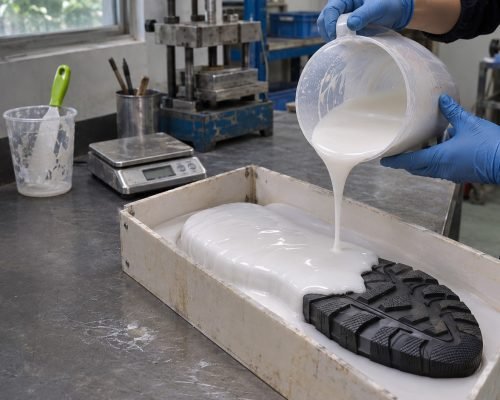
FLOW
Reach narrow grooves and fine tread without trapping avoidable air.
DETAIL
Reproduce surface grain, edges, lugs, channels, and identification marks.
RELEASE
Flex around undercuts while protecting the master and cured sample.
VALUE
Choose a practical mold life and material cost for the sampling volume.
WHAT FOOTWEAR BUYERS ACTUALLY NEED
A Repeatable Mold—Not Just “ 5-20 Shore A ”
Hardness alone does not decide whether a shoe mold fills cleanly, demolds without tearing, and reproduces the next sample accurately.
CREKEM reviews the master material, tread depth, undercuts, mold size, casting media, expected pulls, room temperature, and production timing before matching viscosity, hardness, working time, cure speed, color, and catalyst ratio.
SHOE MOLD MAKING APPLICATIONS
One Silicone Route, Different Footwear Tooling Jobs
General tin-cure silicone is commonly selected for economical duplication and development work where good flow, useful flexibility, and straightforward processing matter.
Sneaker & Sports Outsole Prototypes
Reproduce multi-directional tread, flex grooves, sidewall textures, and branded surface detail for design evaluation.
Work Boot & Safety Shoe Lugs
Handle deeper patterns and heavier undercuts with the right hardness, section thickness, and opening plan.
Dress Shoe & Casual Sole Patterns
Capture fine anti-slip textures, edge lines, heel details, and smooth cosmetic surfaces.
EVA / Rubber Pattern Duplication
Copy existing outsole masters and development patterns for sample tooling and design revisions.
PU Resin & Prototype Casting
Make flexible molds for compatible casting resins used in visual, fit, or tooling development trials.
Plaster Models & Foundry Patterns
Duplicate footwear masters, sole forms, and patterns for downstream plaster or sand-casting workflows.
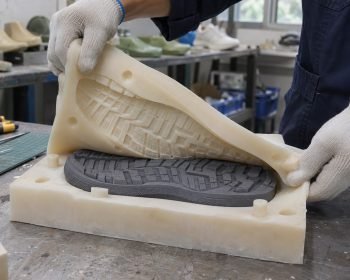
WHY GENERAL TIN-CURE SILICONE
The Practical Starting Point for Most Shoe Mold Sampling
General tin silicone offers a useful balance of cost, flow, cure reliability, and flexibility for routine shoe mold making. It is often more forgiving than platinum systems when the master material or workshop is not tightly controlled.
- Low enough viscosity to wet fine tread and surface grain
- Shore A range selected around geometry—not by habit
- Good tear resistance for repeated demolding when seams and thickness are correct
- Adjustable catalyst speed for seasonal workshop conditions
- Compatible with thixotropic additive when brushing or local build is needed
- Economical for prototypes, design changes, and moderate production runs
RECOMMENDED MATERIAL ROUTE
General Tin-Cure Silicone Rubber
The default CREKEM route for economical shoe sole mold making, footwear sampling, outsole pattern duplication, and compatible PU resin or plaster model workflows.
PRACTICAL GUIDES
Reduce Risk Before the Full Pour
Compare cure chemistry, hardness, viscosity, geometry, and production requirements.
Improve weighing, mixing, degassing, detail coating, and pouring practice.
SHOE MOLD WORKFLOW
Protect the Master. Prove the Process. Then Scale.
Run a small compatibility and cure test before coating a valuable outsole master or committing a full batch.
01 — AUDIT THE MASTER
Identify the master material, sealer, surface texture, undercuts, parting line, release needs, and any contamination risk.
02 — DESIGN THE MOLD
Plan mold-box clearance, seams, keys, vents, pour points, wall thickness, and the direction the outsole will release.
03 — MIX & POUR
Weigh accurately, mix the catalyst completely, degas when needed, brush a detail coat into deep features, then pour in a narrow stream.
04 — CURE & VERIFY
Demold only after full cure, inspect for bubbles and thin zones, make a trial casting, and document the approved ratio and timing.
COMMON SHOE MOLD PAIN POINTS
Trace the Defect Back to the Process
Most failures come from a combination of grade selection, mold design, mixing, air control, and cure conditions.
Deep lugs, lettering, and horizontal ledges hold air. Brush a thin detail coat into the lowest points, vent closed pockets, pour from one corner in a narrow stream, and vacuum-degas when the geometry and batch justify it.
Likely causes include thin sections, sharp inside corners, unsuitable hardness, low tear strength, poor seam placement, or aggressive demolding. Redesign the opening path and reinforce stress zones before simply selecting a harder rubber.
The mold may be too soft, unevenly supported, or removed before full cure. Check mold wall thickness, support-box fit, registration, casting position, and the balance between rubber flexibility and dimensional support.
Incorrect catalyst measurement, incomplete mixing, low temperature, moisture, contamination, or an incompatible master coating can interfere. Use accurate scales, clean tools, approved ratios, and a spot cure test with the actual master stack.
High viscosity, trapped air, contaminated surfaces, or poor wetting can soften detail. Clean the master, use a fine detail coat, control air, and select a viscosity appropriate to the narrowest features.
Oversized mold boxes, excessive clearance, thick walls, and avoidable dead volume increase cost. Calculate the mold volume, reduce unused space, and consider a supported skin or multi-part construction when geometry makes a solid block inefficient.
GRADE-MATCHING CHECKLIST
Send the Details That Change the Recommendation
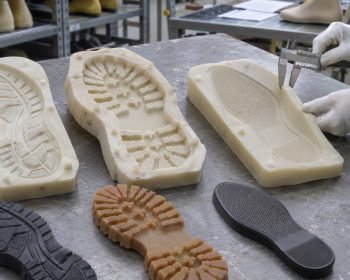
A useful quotation needs more than “shoe mold silicone.” Photos and process details let CREKEM narrow the right general tin silicone and sample plan.
- Outsole or master photos, dimensions, and master material
- Tread depth, undercuts, fine texture, lettering, and sidewall detail
- Planned one-piece, split, cut, block, or supported mold construction
- Casting material and maximum casting temperature
- Expected pulls, dimensional tolerance, and target surface finish
- Room temperature, desired working time, cure time, color, package size, and monthly demand
SHOE MOLD MAKING FAQ
Questions Footwear Buyers Ask Before Ordering
General tin-cure RTV-2 silicone is the practical starting point for many shoe sole prototypes and pattern-duplication jobs because it combines useful flow, flexibility, and cost control. The final grade depends on tread depth, undercuts, mold size, casting material, and required pulls.
Shore A 20–30 is a common starting range, not a universal rule. Deep undercuts may need easier flex; large open molds may need more body or stronger support. Evaluate hardness together with tear strength, elongation, viscosity, and mold construction.
Tin-cure silicone is generally the economical, forgiving choice for routine shoe mold making. Platinum silicone is considered when very low shrinkage, higher dimensional stability, or specific performance is required, but it needs stricter compatibility control.
Yes. Correctly selected and applied RTV-2 silicone can capture fine grain, lettering, logos, stitching channels, and complex tread. Clean wetting, a bubble-free detail coat, and controlled air removal are essential.
Vacuum degassing improves consistency for air-sensitive details and larger batches, but careful mixing, a detail coat, narrow-stream pouring, and venting can also reduce bubbles. The best method depends on viscosity, geometry, batch size, and available equipment.
Only within the supplier’s approved range. Excess catalyst can shorten working time, increase shrinkage, or reduce mold life. Ask for a fast, medium, or slow catalyst option matched to season and batch size rather than improvising the ratio.
Calculate the filled mold-box volume, subtract the master volume, add a small process allowance, then convert volume using the product density. Efficient box clearance and planned wall thickness prevent unnecessary material cost.
Use the actual master, sealer, release agent, silicone, catalyst, and casting material. Confirm surface cure, detail, working time, demolding, dimensional behavior, and several repeat castings under real workshop temperature.
TALK TO A SHOE MOLD SILICONE SPECIALIST
Send the Outsole. Get a Grade and Test Plan That Fit the Job.
Share the master material, size, tread depth, undercuts, mold method, casting media, working temperature, and expected pulls. CREKEM will recommend a suitable general tin silicone and sample test.