
SILICONE FOR SOAP MOLD MAKING
Silicone for Soap Mold Making: Release Cleanly, Repeat Every Detail
CREKEM RTV-2 liquid silicone rubber for soap mold making helps manufacturers create flexible, detailed, and durable custom molds—from economical everyday bar molds to translucent, low-shrinkage molds for cold-process, hot-process, melt-and-pour, artisan, and production soap.
- Shore A 10–20 for flexible demolding without a floppy mold
- General tin-cure silicone and translucent platinum-cure silicone
- Grade matching for cold-process, hot-process, and melt-and-pour workflows
DETAIL
Capture logos, botanicals, lettering, textures, and clean bar edges.
DEMOLD
Flex around undercuts while supporting the soap during release.
REPEAT
Maintain consistent cavity shape through prototypes and production batches.
SOURCE
Select cure system, hardness, viscosity, pack size, and supply plan together.
THE BUYER'S REALITY
A Good Soap Mold Is a Production Tool
The mold must fill fine detail, hold its shape, release a soft or fully cured bar, and survive the number of pours your business expects.
CREKEM matches liquid silicone to the master, mold geometry, soap process, desired transparency, cure-inhibition risk, cycle target, and budget—not hardness alone.
Soap Sticks or Tears
The rubber may be too firm, the cavity may have trapped undercuts, or the soap may be demolded before it has enough green strength.
Fine Detail Looks Soft
High viscosity, trapped air, poor surface wetting, or a weak master can blur logos and botanical texture.
Mold Bows or Distorts
Silicone that is too soft—or a mold wall that is too thin—can change bar weight and edge geometry.
Platinum Silicone Stays Tacky
Sulfur clay, latex, amines, some 3D-print resins, tin residues, and other contaminants can inhibit cure.
Bubbles Mark the Surface
Air introduced during mixing or trapped against high points can create pinholes and missing detail.
Mold Life Is Too Short
Thin tear zones, aggressive demolding, unsuitable chemistry, or poor cleaning can turn a low unit price into a high cost per bar.
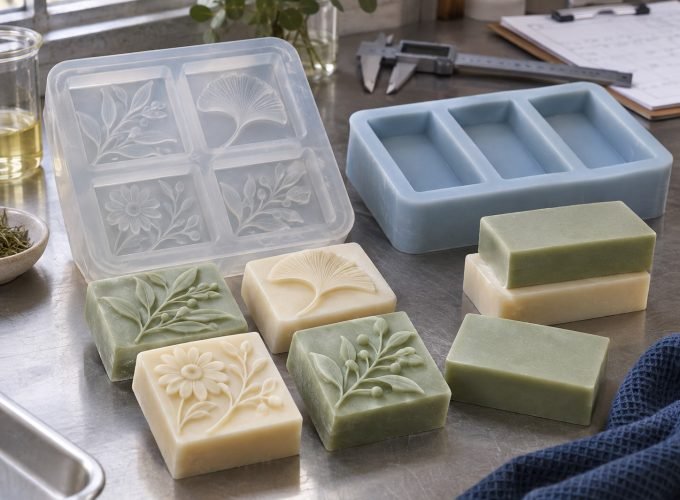
SELECT THE CURE SYSTEM
Tin Cure or Translucent Platinum Cure?
Both systems can make excellent soap molds. The better choice depends on the master, required mold life, transparency, dimensional stability, and target cost.
- Choose general tin silicone for economical molds, forgiving cure behavior, and routine non-food soap production.
- Choose translucent platinum silicone for very low shrinkage, longer mold life, visual control during cutting or demolding, and premium detailed molds.
- For any new master—especially a 3D print—run a small compatibility test before committing to the full mold.
GENERAL TIN-CURE SILICONE
Practical Value for Everyday Soap Molds
- Lower material cost for prototypes and short-to-medium production runs
- Good flow and detail reproduction for bars, loaves, reliefs, and simple 3D forms
- More tolerant of many master materials than platinum systems
- Best where food-contact declarations and maximum dimensional stability are not required
TRANSLUCENT PLATINUM SILICONE
Low Shrinkage for Premium Repeat Production
- Excellent detail fidelity and very low cure shrinkage
- Translucency helps reveal bubbles, seams, and the soap during demolding
- Longer mold life and stable geometry for repeat production
- Requires careful master compatibility and contamination control
RECOMMENDED HARDNESS
How to Choose Silicone for Soap Mold Making
For most soap molds, Shore A 10–20 provides a practical balance between flexible demolding and dimensional stability, allowing the mold to peel away from detailed soap while remaining firm enough to keep the cavity stable; however, mold geometry and wall thickness still matter.
| Starting point | Best fit | Watch for |
|---|---|---|
| Shore A 10 | Deep relief, undercuts, delicate or intricate bars | Support the mold body to prevent bowing |
| Shore A 15 | Balanced general-purpose bar and cavity molds | Confirm tear strength at thin details |
| Shore A 20 | Larger cavities, loaf molds, flatter geometry, repeat handling | Check demolding force around deep undercuts |
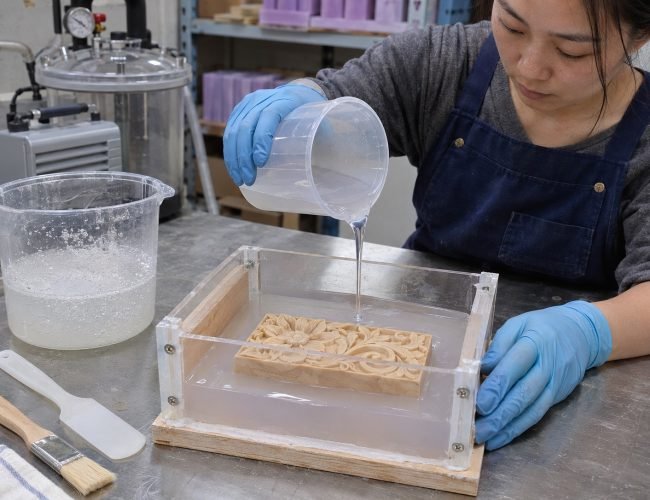
MOLD-MAKING WORKFLOW
From Master to Production-Ready Soap Mold
01 — PREPARE THE MASTER
Seal porous surfaces, remove dust, plan parting lines, and test compatibility.
02 — MEASURE & MIX
Follow the specified ratio by weight, scrape the sides and base, and mix until uniform.
03 — DEGAS OR CONTROL THE POUR
Vacuum degas when required, then pour a thin stream into the lowest point and let silicone rise over the master.
04 — CURE & DEMOLD
Maintain the recommended temperature and full cure time before opening the mold.
05 — TRIAL WITH YOUR SOAP
Verify filling, release, dimensions, surface finish, cleaning, and repeat cycles before scaling.
DETAIL THAT SELLS THE FINISHED SOAP
Turn a Signature Design Into a Repeatable Product
Floral relief, branded faces, seasonal collections, and custom bar geometry only create value when the mold reproduces them cleanly from the first pour to the target production cycle.
- Low-viscosity flow reaches narrow petals and engraved lines
- Balanced Shore A 10–20 flexibility supports gentle demolding
- Strong tear behavior protects thin relief and mold edges
- Controlled shrinkage helps maintain the intended bar size and finish
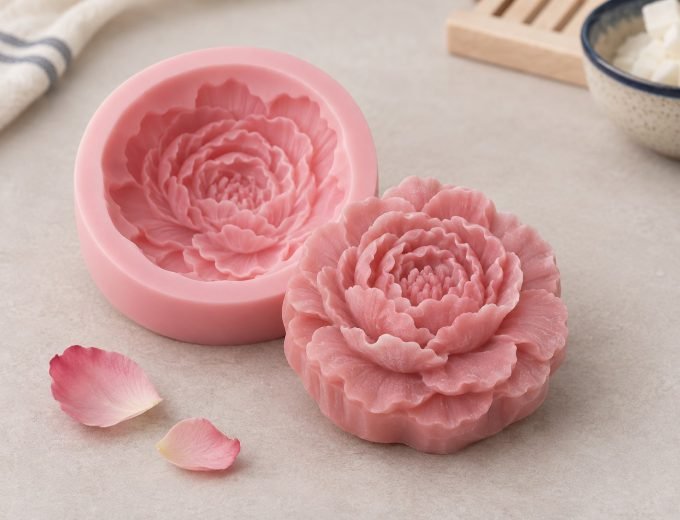
Custom Bar & Logo Molds
Brand marks, lettering, geometric faces, guest-size bars, and signature product shapes.
Botanical & Relief Soap
Floral, leaf, carved, embossed, and highly textured decorative surfaces.
Loaf & Slab Molds
Stable flexible liners and cavities for cutting uniform bars after cure.
Multi-Cavity Production
Repeatable fill volume, consistent edges, and efficient batch demolding.
3D & Two-Part Molds
Complex forms, deeper undercuts, seam planning, vents, and registration keys.
Private Label & OEM Supply
Grade matching, sample validation, packaging discussion, and repeat production supply.
SPECIFY THE MOLD, NOT JUST THE RUBBER
What CREKEM Needs to Recommend a Grade
Photos, dimensions, and process details usually narrow the choice faster than a generic hardness request.
- Master material: wood, resin print, acrylic, metal, plaster, clay, or existing soap
- Soap process: cold process, hot process, melt-and-pour, or another formulation
- Mold type: open-face, loaf, multi-cavity, cut mold, or two-part mold
- Part size, deepest undercut, wall thickness, and required surface detail
- Target production cycles and expected annual silicone volume
- Preferred cure system, color or translucency, viscosity, working time, and cure time
- Packaging, private-label, compliance documents, and destination market
SOAP MOLD SILICONE FAQ
Questions Buyers Ask Before Sampling
Use these answers as a starting point; validate the final grade with your master and actual soap process.
For most soap molds, start with a pourable RTV-2 silicone around Shore A 10–20. General tin-cure silicone is economical and forgiving; translucent platinum-cure silicone offers very low shrinkage, longer service life, and excellent detail. The master material and production target determine the final choice.
Shore A 10 is easier to flex around deep relief and undercuts, while Shore A 20 offers more body for larger cavities and repeat handling. Shore A 15 is often a useful balanced starting point. Mold thickness and support structure must be considered with hardness.
Yes, tin-cure RTV silicone is widely used for non-food soap molds. Confirm compatibility with the specific soap formulation, pigments, fragrance oils, master, release system, and required mold life through a trial.
Cure inhibition can come from sulfur clay, latex, amines, some adhesives, tin-cure residues, and incompletely post-cured 3D-print resins. Clean and seal the master where appropriate, then run a small test patch before a full pour.
Many soaps release from silicone without a release agent, but the answer depends on soap type, cure stage, cavity geometry, and surface texture. Test first; unnecessary release can affect the soap surface and mold cleaning.
Mix without whipping air, vacuum degas when the grade and process require it, brush a thin detail coat over the master, and pour slowly into the lowest point. Mold orientation should let air escape rather than trap at high details.
Customization may be available subject to formulation and production validation. Share the target performance, pack size, order volume, market, and sample acceptance criteria for assessment.
TALK TO A SILICONE SPECIALIST
Turn Your Soap Master Into a Repeatable Mold
Send the master material, mold dimensions, soap process, target cycles, and preferred hardness. CREKEM will help shortlist a general tin silicone or translucent platinum silicone for sample testing.