APPLICATION ENGINEERING · CONCRETE STAMPING
Polyurethane Rubber for Concrete Stamps
Manufacture durable, semi-rigid concrete stamp mats with CREKEM liquid polyurethane rubber. Designed for detailed stone, slate, brick and wood textures, CREKEM polyurethane mold rubber provides controlled flexibility, strong tear resistance and excellent abrasion resistance for repeated professional use.
- Low-viscosity flow for fine texture reproduction
- 45A, 60A and 80A options for skins, semi-rigid mats and firm tools
- Custom color, viscosity and cure-profile support
START WITH THE TOOL DESIGN
Send the master and use condition first
Share the master material, pattern depth, mat dimensions, target thickness, desired flexibility, reinforcement method, climate and current failure mode.
45A / 60A / 70A / 80A
Hardness options for texture skins, semi-rigid stamp mats and firmer concrete texturing tools.
Stable Yet Demoldable
Holds its shape during positioning and tamping while retaining enough flexibility for demolding and handling.
Built for Durability
Designed to withstand repeated stamping, lifting and job-site handling while protecting fine texture details.
Customizable
Formulation options can be adjusted for tool design, processing requirements and finished stamp color.
THE COST IS NOT ONLY THE RUBBER
What Makes a Stamp Set Fail in the Market?
Stamp makers sell a working system, not a decorative sheet. Thin edges, trapped air, wrong hardness and rapid wear create callbacks, replacement cost and inconsistent impressions.
01 · TEARING
Thin edges split
Deep joints and flexible corners become failure points when tear strength is inadequate.
02 · LOST DETAIL
Texture looks flat
Bubbles or poor wetting can erase the grain that makes the finish believable.
03 · WRONG FEEL
Too soft or too rigid
The wrong hardness slows alignment, reduces support or complicates demolding.
04 · SHORT LIFE
Abrasion eats margin
Tamping and repeated concrete contact expose weak formulations quickly.
WHY POLYURETHANE
Flexible to Demold. Tough Enough to Work.
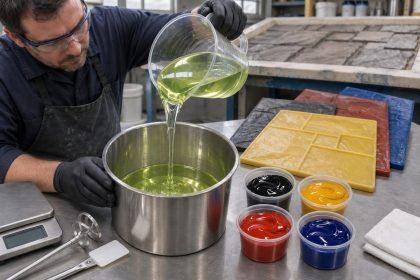
Polyurethane is commonly selected for concrete stamping tools because it combines detailed reproduction with tear and abrasion resistance.
- Flows into pores, grain and narrow grout lines
- Supports deep relief and vulnerable edges
- Bends for lifting and positioning on site
- Maintains a rugged working surface
- Can be adjusted around the tool format
MATCH THE HARDNESS TO THE TOOL
Three Practical Starting Points
Select the grade from how the finished tool must behave, then validate it against the real master, section thickness and cure conditions.
45A · FLEXIBLE
Texture Skins & Deep Relief
- Conforms to uneven areas
- Releases from complex masters
- Useful for touch-up tools
60A · BALANCED
General-Purpose Stamp Mats
- Balanced flexibility and support
- Stable handling for pattern sets
- Starting point for main mats
80A · FIRM
Defined Joints & Firm Tools
- Greater dimensional support
- Firm response during tamping
- Controlled flat applications

BUILD A COMPLETE STAMP SYSTEM
Main Mats, Flexible Skins and Matching Details
Customer catalogues show that professional sellers compete through coordinated pattern families, not one isolated mat. A practical line combines main mats with flexible skins, borders and touch-up tools.
- Natural slate, ashlar and flagstone
- Cobblestone, river stone and European stone
- Running bond and herringbone brick
- Antique timber and wood plank
- Seamless textures, borders and medallions
- Custom logos and project patterns
WHERE CONCRETE STAMP TOOLS CREATE VALUE
More Than Patios: Six Application Routes for Polyurethane Stamps
Concrete stamp manufacturers serve horizontal paving, vertical finishes, themed environments and repeatable precast production. The tool format changes with the surface—from firm main mats to texture skins, rollers, liners and custom detail stamps.

PATIOS · DRIVEWAYS · WALKWAYS
Patios, Driveways & Horizontal Concrete
Create slate, stone, brick and paver finishes across patios, pool decks, driveways, plazas and pedestrian paths. Main mats provide alignment and support across large areas.
RETAINING WALLS · FACADES
Vertical Concrete & Walls
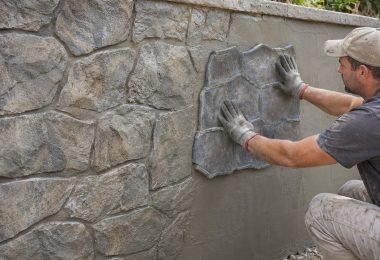
Use vertical stamps and texture tools on retaining walls, facades, columns, masonry overlays and outdoor kitchens where a flat floor mat cannot follow the surface.
TREE BARK · FAUX WOOD
Faux Trees, Branches & Timber
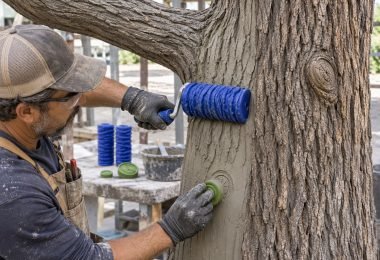
Tree-bark rollers, knot stamps and wood-grain skins reproduce trunks, branches, stumps, planters, concrete furniture and timber-style wall finishes.

ROCKWORK · THEMED ENVIRONMENTS
Artificial Rock & Landscape Features
Texture artificial rocks, waterfalls, caves, zoo habitats, theme-park scenery and garden features with skins that follow sculpted three-dimensional forms.

PRECAST · FORM LINERS
Precast & Architectural Details
Produce textured wall panels, stair risers, pool coping, fire-pit liners, step inserts and other repeatable precast architectural components.
BORDERS · CUSTOM PATTERNS
Borders, Medallions & Custom Stamps
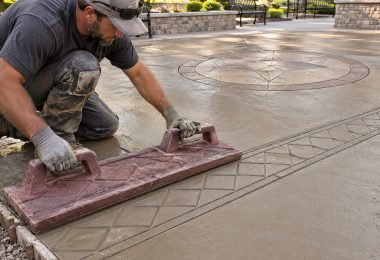
Support the production of borders, medallions, custom motifs and touch-up tools that expand a stamp manufacturer’s product range.
REFERENCE PROPERTIES
Compare Published CREKEM Grades
Use these values for initial screening only. Confirm the current TDS and sample performance before tooling decisions.
PRODUCTION WORKFLOW
From Master to Repeatable Stamp Mat
Stable results come from controlling the master, mix, pour, cure and acceptance criteria together.
01 · PREPARE
Clean, seal and release the master. Define mat thickness and reinforcement before mixing.
02 · MEASURE & MIX
Condition both components, weigh accurately and scrape the sides and bottom.
03 · POUR FOR DETAIL
Start low and let a controlled ribbon rise across the texture to reduce trapped air.
04 · CURE & DEMOLD
Control temperature and humidity. Demold after the specified cure.
05 · VALIDATE
Check dimensions, hardness, surface detail, edges and field handling.
PROTECT THE TOOL
Care Instructions Customers Will Use
The reviewed catalogues consistently treat cleaning, storage and correct tamping as part of tool life.
Use a smooth tamper
Avoid sharp corners that concentrate impact.
Clean after use
Remove release-agent and concrete residue.
Keep out of direct sun
Avoid prolonged heat and UV between jobs.
Store flat and dry
Support mats in a cool covered area.
STAMP-MAKER QUESTIONS
Details That Change the Recommendation
The right formulation depends on the complete tool design, not hardness alone.
60A is a practical starting point for many general-purpose mats. Use 45A for greater flexibility and consider 80A where firmer support is preferred. Validate on the actual master.
Polyurethane is commonly selected when tear strength and abrasion resistance are central. Silicone may be preferred where temperature resistance or very easy release matters more.
Commercial systems often combine multiple main mats with texture variations, plus flexible skins and touch-up tools. Set size depends on the pattern repeat and workflow.
Prepare and dry the master, mix without whipping air, scrape the container and pour a controlled thin stream into the lowest point.
CREKEM can review color, viscosity, hardness and cure behavior for qualified projects.
Service life depends on formulation, geometry, thickness, handling, release agents, cleaning and storage. Do not assume a fixed impression count without controlled validation.
TALK TO A POLYURETHANE SPECIALIST
Send the Master, Target Hardness and Current Failure Mode
CREKEM will help shortlist a grade and plan sample validation before production volume.