
Home › Applications › Platinum Silicone Insoles for Shoes
PLATINUM SILICONE FOR INSOLES & FOOT-CARE COMPONENTS
Silicone Insoles Built for Comfort—and Repeatable Production
RTV-2 platinum-cure silicone rubber for molded shoe insoles, orthotic inserts, heel cups, arch-support pads, pressure-relief parts, and flexible foot-care components.
- Soft 5–15 Shore A direction for cushioning or support-focused designs
- Convenient 1:1 addition-cure processing with low shrinkage
- Grade matching from sample validation to repeat bulk supply
COMFORT
Tune softness and elastic recovery to the intended foot-contact feel.
SUPPORT
Balance cushioning with enough body to hold the designed arch and heel geometry.
PROCESS
Control mixing, air, cure, thickness, and demolding for consistent parts.
SUPPLY
Validate a sample, lock the specification, then scale packaging and repeat orders.
THE BUYER’S REAL QUESTION
Soft Enough to Cushion—Stable Enough to Manufacture
An insole can feel comfortable in one sample and still fail in production through trapped air, uneven thickness, weak edges, slow recovery, or batch variation.
CREKEM starts with the finished part: full-length insole, orthotic insert, heel cup, gel pad, arch support, or toe-care component. Then we match hardness, viscosity, tear behavior, working time, cure schedule, color, molding method, and order scale.
Too Soft or Bottoms Out
A very soft rubber may cushion initially but compress too far under load or lose the intended support geometry.
Too Firm to Wear Comfortably
Higher hardness or excessive section thickness can create pressure points and make the part difficult to trim or fit.
Bubbles and Surface Voids
Air from mixing or trapped high points can leave weak zones, visible defects, and inconsistent foot-contact surfaces.
Edges Tear During Demolding
Thin rims, sharp transitions, premature demolding, or insufficient tear strength concentrate stress.
Part Thickness Varies
Uneven mold filling, poor venting, silicone flow, clamping, and cure conditions can change feel from pair to pair.
Pilot Sample Does Not Scale
Mixing equipment, batch size, temperature, degassing, and cure control must be reproduced when moving to volume production.
CHOOSE BY FUNCTION
Start With the Part’s Job—not a Generic Shore Number
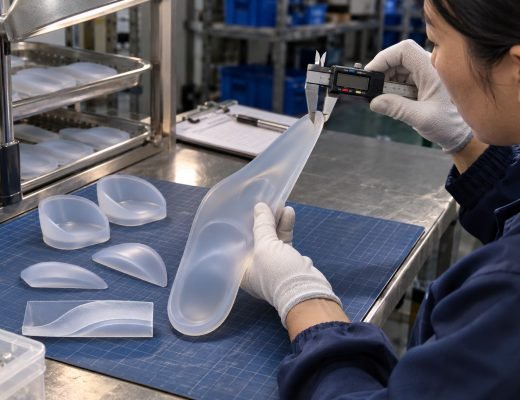
Hardness is only a starting point. Foot-contact feel also depends on thickness, geometry, compression, elastic recovery, tear strength, surface finish, and how the insole is supported inside the shoe.
| Starting direction | Typical buyer goal |
|---|---|
| Shore A 5 | Very soft cushioning zones and pressure-relief pads |
| Shore A 10 | Balanced comfort insoles, heel cups, and flexible inserts |
| Shore A 15 | More supportive arch or heel components where shape retention matters |
SILICONE INSOLE APPLICATIONS
One Material Platform, Different Foot-Care Products
Specify the part geometry and performance target so softness, strength, processing, and cost are considered together.
Full-Length Comfort Insoles
Soft, resilient molded layers for daily footwear and comfort-focused private-label products.
Orthotic Insoles & Inserts
Customized geometries requiring controlled support, stable dimensions, and consistent thickness.
Heel Cups & Heel Pads
Localized cushioning parts designed around heel contact, edge durability, and repeated compression.
Arch-Support Pads
Flexible molded components that must retain their profile while adapting to movement.
Pressure-Relief Components
Very soft zones, metatarsal pads, and targeted cushioning pieces that require careful bottom-out testing.
Toe Separators & Foot-Care Pads
Small flexible parts where soft touch, tear resistance, clean molding, and easy demolding matter.
WHY PLATINUM-CURE SILICONE
Clean 1:1 Processing With Low-Shrinkage Part Stability
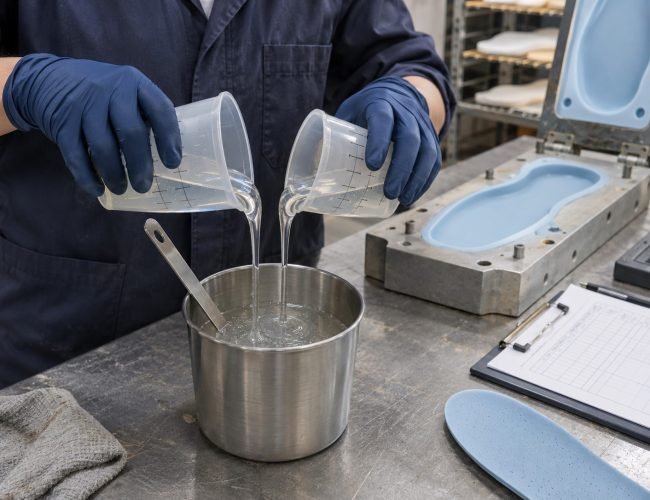
Addition-cure platinum silicone is the normal material direction for CREKEM insole applications because it combines soft elastic behavior with stable curing and dimensional control.
- 1:1 mix ratio simplifies weighing or metered dispensing
- Low cure shrinkage helps preserve molded thickness and geometry
- Translucent base supports pigmenting and visual air inspection
- Soft 5–15 Shore A range covers cushioning to support-oriented components
- Good flexibility supports trimming, fitting, and repeated deformation
- Formulation direction can be discussed for viscosity, working time, cure, color, and packaging
HARDNESS
5–15 Shore A sample directions according to cushioning and support.
VISCOSITY
Match hand mixing, vacuum degassing, dispensing, casting, or injection equipment.
WORKING & CURE TIME
Set realistic fill, air-release, demolding, and daily output targets.
COLOR & PACKAGING
Discuss translucent or colored parts, sample size, 20/25 kg packs, drums, and repeat supply.
FROM PILOT TO PRODUCTION
Validate the Process Before You Lock the Purchase Order
Test the exact mold, pigment, equipment, section thickness, cure temperature, and acceptance criteria intended for production.
01 — DEFINE THE PART
Share drawings, photos, thickness map, target feel, support zones, surface finish, color, and use environment.
02 — SHORTLIST & SAMPLE
Select a hardness and processing direction; review TDS/SDS and run a representative mold trial.
03 — VERIFY PERFORMANCE
Check mixing, bubble release, fill, cure, demolding, dimensions, tear points, compression feel, recovery, and aging criteria.
04 — SCALE THE SAME WINDOW
Reproduce mix ratio, equipment, batch temperature, degassing, mold preparation, cure, and post-cure as volume increases.
DEMOLDING & PART DESIGN
Protect Thin Edges Before They Become Scrap
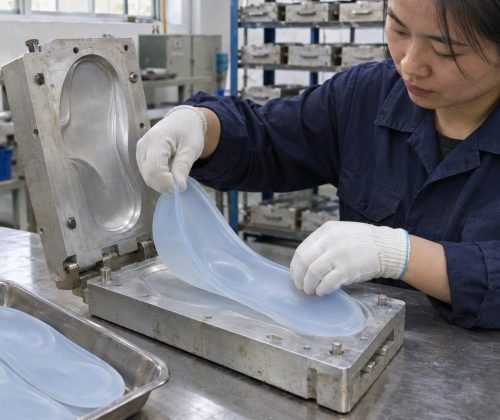
Soft silicone can flex around undercuts, but thin rims and abrupt thickness changes still concentrate stress. Design the mold and demolding direction together with the rubber.
- Add practical radii at transitions and avoid knife-edge sections
- Vent high points and fill from a direction that lets air escape
- Demold only after the specified cure has developed enough strength
- Use controlled peel rather than pulling from one narrow edge
- Inspect thickness and parting lines during sample approval
GRADE-MATCHING CHECKLIST
Send the Details That Change the Recommendation
A precise request produces a more useful sample than asking only for “soft silicone.”
- Product: full insole, orthotic insert, heel cup, arch pad, pressure-relief pad, or other
- CAD, dimensions, thickness range, support zones, undercuts, and target surface
- Target hardness or a current approved comparison sample
- Molding method: open casting, compression mold, dispensing, or injection process
- Equipment, batch size, degassing method, mold material, cure temperature, and cycle target
- Required tensile, tear, elongation, compression, recovery, aging, or compliance test method
- Color, annual usage, sample quantity, packaging, destination, and forecast schedule
SILICONE INSOLE FAQ
Questions Buyers Ask Before Sampling
Two-part platinum-cure, or addition-cure, silicone is commonly evaluated for molded comfort insoles, orthotic inserts, heel pads, arch supports, and other foot-care parts. The final grade depends on hardness, geometry, processing, and the required performance tests.
CREKEM commonly starts evaluation in the 5–15 Shore A range. Around Shore A 5 may suit very soft cushioning zones; Shore A 10 is a balanced starting point; Shore A 15 may give more body for support-focused parts. Thickness and geometry can change feel as much as hardness.
Each material has a different cost, weight, feel, process, and durability profile. Silicone offers moldable geometry, elastic recovery, and stable flexible behavior. Compare it with the actual gel, foam, TPE, or PU system using the finished shoe design and target test methods.
Yes, compatible silicone pigments may be used subject to formulation and cure validation. Test the exact pigment loading because colorants and additives can change appearance, viscosity, cure, and final properties.
Air can be introduced during mixing or trapped by the mold geometry. Control mixing speed, vacuum degassing where appropriate, dispensing path, vents, mold orientation, viscosity, and cure timing.
Review edge radius, minimum section, mold parting line, cure time, demolding direction, and tear strength. A harder silicone alone may not fix a stress-concentrating design.
Sample and technical-document support can be discussed after the application, target hardness, process, quantity, and destination are shared. Validate the selected grade in your real production conditions before bulk ordering.
Customization may be assessed against formulation feasibility, test criteria, volume, and production validation. Share your current material, equipment, acceptance limits, annual demand, and packaging preference.
TALK TO A SILICONE SPECIALIST
Turn Your Insole Design Into a Repeatable Molded Part
Send the product drawing, thickness, target hardness, molding method, test criteria, volume, and current problem. CREKEM will help shortlist a platinum silicone direction for sample validation.