
Home › Applications › Silicone Vacuum Bag
COMPOSITES VACUUM BAGGING
Platinum Silicone for Reusable Vacuum Bags
Build a reusable silicone vacuum bag for composite resin infusion with two-part, addition-cure platinum silicone. Tell CREKEM how you apply the silicone, what your tool looks like and how the finished bag will be used.
- Reduce repeat film cutting and taping on stable tooling
- Match machine spray or brush-on application to your tooling
- Qualify the silicone on your actual tool and resin system
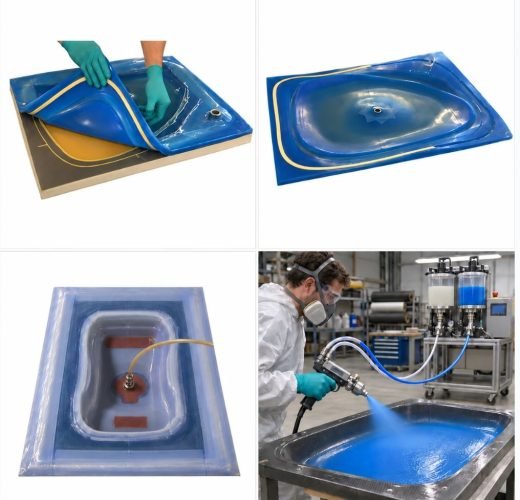
01
Fit the Tool
Form the membrane around the actual contours and flange.
02
Hold Vacuum
Check the seal, ports and membrane before resin enters.
03
Repeat the Setup
Use the same bag on stable tooling once the process is qualified.
04
Track Cost per Part
Compare film, tape, labor and rejects with bag build and maintenance.
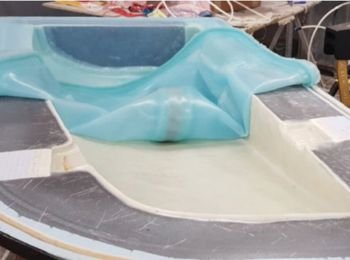
WHEN TO SWITCH
Making the Same Part Again and Again?
A reusable silicone membrane is most useful when part geometry and tooling stay stable. Compare the up-front cost of the bag with what you spend cutting film, laying sealant tape and chasing leaks on every cycle. Disposable film can still make more sense for prototypes, frequent design changes or very short runs.
CREKEM supplies the liquid silicone for making the membrane. Once the membrane has cured and passed a vacuum hold test, the resin infusion setup draws resin through the fiber layup under the finished bag.
COMPOSITE APPLICATIONS
Where a Reusable Silicone Vacuum Bag Fits
Start with one repeat part and prove the complete setup before expanding to other molds.
RESIN INFUSION
Marine & Industrial Panels
For repeat fiberglass hatches, covers and panels, validate resin feed, vacuum takeoff and flow media on the actual tool.
VACUUM BAGGING
Carbon Fiber & Fiberglass Layups
For wet lay-up consolidation, check corner contact, local membrane stretch and release.
DEBULKING
Repeat Composite Layups
For intermediate compaction, qualify fit and vacuum retention before evaluating any heated prepreg cycle.
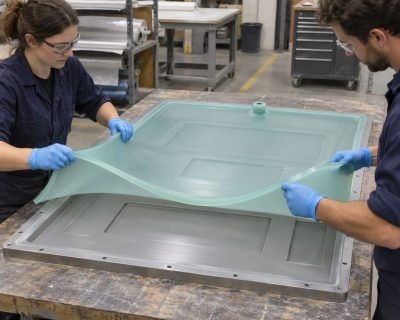
INDUSTRIAL COMPOSITE PANELS
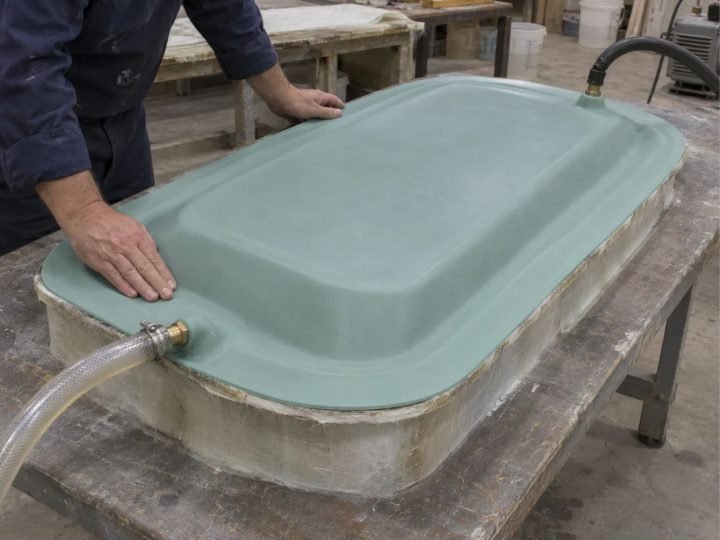
Lift the Cured Membrane From the Tool
After the silicone has cured, lift it gradually from the tooling. Check corners, sealing edges and port areas before fitting the membrane for a vacuum hold test.
MATERIAL SELECTION
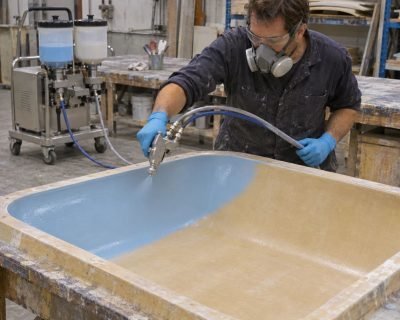
Machine Spray Silicone
For large tools, assess a spray-grade platinum silicone for your A/B meter-mix equipment. The machine meters both components and mixes them at the application head so the operator can build the membrane in layers. For smaller tools and local details, evaluate a brushable grade or a grade with an approved thixotropic additive. The coating should hold on slopes after application without sagging or thinning at corners.
- Compare tear strength, elongation and hardness together.
- Check pumpability, mix ratio and nozzle setup for spray. check sag and working time after adding any approved thickener.
- Confirm gel time, recoat window and demold time separately in the grade-specific TDS. Check cure and layer bonding at your shop temperature.
PILOT BUILD
Qualify One Tool Before Scaling
Use a representative tool section that includes a tight radius, the sealing flange and a port.
01 — Map the tool
Mark deep corners, seal lands and port locations. Decide how the bag will seat without stretching over sharp edges.
02 — Test the surface
Run a cure patch on the real tooling, sealer and release stack. Follow the selected grade’s mix and cure instructions.
03 — Build & inspect
Control layer thickness and check for pinholes or weak spots around corners and fittings.
04 — Prove the cycle
Run an isolated vacuum hold test, then a representative process cycle. Track setup time, part quality and maintenance.
TROUBLESHOOTING
What Is Costing You a Cycle?
Identify where the failure starts before changing the silicone grade.
Isolate the bag from the pump and check the flange, port connections, hoses and membrane for leaks. Define the acceptable vacuum decay for your process before opening the resin feed.
Check whether the bag seats at the radius without tension. If the vacuum holds, verify the resin path, flow media and feed placement separately.
Inspect for sharp transitions, thin areas and repeated handling strain. Review the port support, flange design and tear resistance together.
Check mix ratio, mixing quality and shop temperature, then test the exact tooling and release stack for cure inhibition. Keep mixing tools free from contamination.
BUYER CHECKLIST
Send Your Mold Details for a Grade Match
A mold photo and your process conditions help CREKEM recommend a starting grade and a useful trial.
- Tool dimensions, flange width and tightest corner
- Resin type, maximum tool temperature and dwell time
- Application method, machine model, metering ratio and mixer or nozzle if applicable
- Expected production volume, target thickness and current failure mode
FAQ
Silicone Vacuum Bag Questions
Two-part platinum-cure silicone rubber is a common starting point. Choose a grade based on application viscosity, membrane flexibility, tear strength, resin exposure and service temperature.
There is no universal cycle count. Track seal performance, tearing and resin buildup on your tool; use the trial to set inspection and replacement criteria.
Compatibility depends on the silicone grade and resin formulation. Test actual resin contact at process temperature and inspect release, swelling and membrane condition after repeated cycles.
Use a grade qualified for your machine. A brush-on mix can be too thick for reliable pumping or mixing. Confirm the ratio basis, feed viscosity, nozzle and additive compatibility with the equipment and material suppliers.
A thixotropic additive is selected to control sag. Set the application window using the grade’s working time, gel time and demold time. Confirm these at shop temperature with the approved additive and dosage.
Qualify the grade and complete assembly for peak temperature, dwell, pressure and repeated cycling. An ambient infusion trial does not qualify an oven or autoclave process.
Compare bag fabrication and maintenance cost per accepted part with film, tape, bagging labor and rework. Use measured cycle times and a conservative service-life estimate from your pilot.
Start With One Mold and a Trial Sample
Send your mold photo, resin type and process temperature to request a platinum silicone grade recommendation and TDS.